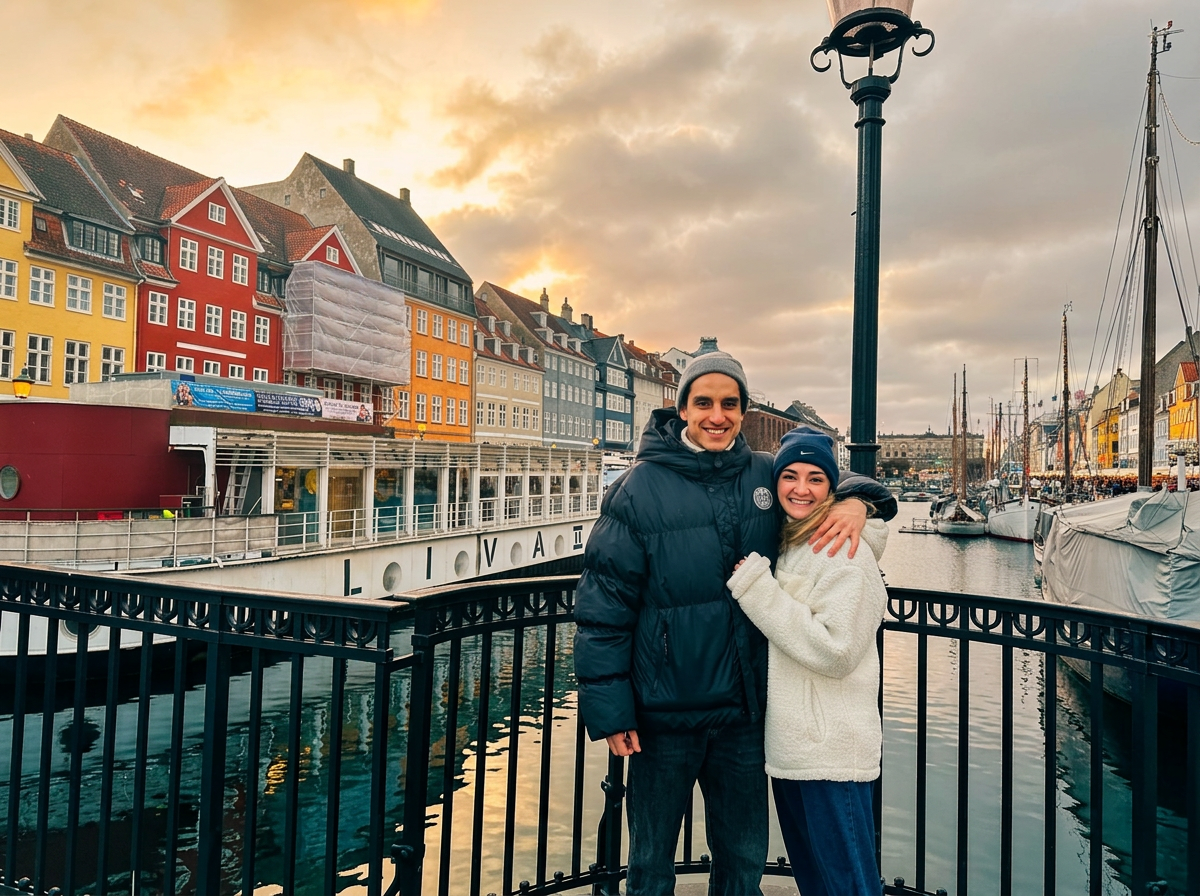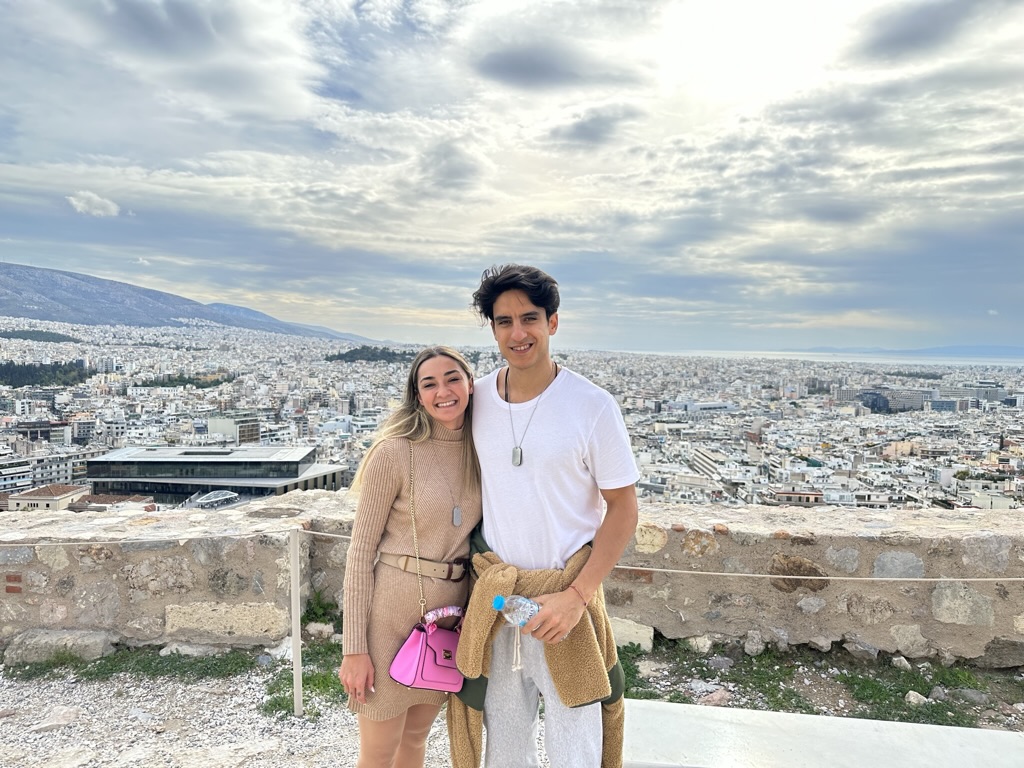
Our story
Our story
Welcome, all of us together, to Strasbourg — the city that calls itself the "Capitale de Noël", with its half-timbered houses, canals and squares that smell of mulled wine 🎄💛 Sitting right between France and Germany and living both cultures at once, this little capital was the first stop on our Christmas route.
December 2023: when we landed in Stuttgart from Athens, we'd slept a grand total of 2 hours in 48 😵 We picked up the car and reached Strasbourg in 2 hours; my love drove, I slept 🤓 It was the first Christmas market trip of my life — and with the most special person in my life, too. I'd never drunk so much mulled wine or eaten so many Nutella crêpes. And we fell head over heels for Petite France 😻
The city, in a nutshell
The city, in a nutshell
Strasbourg is the capital of Alsace, the French region on the German border. Together with Brussels and Luxembourg it's one of the three capitals of the European Union; the European Parliament, the Council of Europe and the European Court of Human Rights are all here. But don't you dare picture a "serious, boring city of civil servants" — it's quite the opposite 💛
It changed hands between France and Germany four times and has been French since 1944. The result: French people speaking with a German accent, German-style crêpes and a sweet city that blends both cultures. And we loved this fact: Lyon's old name was Lugdunum, Paris's was Lutetia, and Strasbourg's was Argentoratum — meaning "silver" ✨
The old town, Grande Île, has been on the UNESCO World Heritage list since 1988. In 2017 the Neustadt, built during the German period, was added to the list too.
Neighbourhoods
Neighbourhoods
Grande Île
The island encircled by the Ill River — in other words, the old town. The cathedral, Place Kléber and most of the Christmas markets are here.
Petite France
Canals, flower-filled windows and half-timbered houses. Strasbourg's postcard 😻
Neustadt
Boulevards and grand buildings from the German period (1871–1918). With the Palais du Rhin and the university buildings, it's a whole different Strasbourg.
Krutenau
The student and local bar neighbourhood — perfect for an evening out.
European Quarter
The European Parliament and Court of Human Rights buildings; if you're interested, a short visit by tram.
Sights
Sights
Strasbourg is a small city — stay in the centre and you can walk everywhere. The classic route starting from the station side: Place Kléber → Cathedral → Place Gutenberg → Palais Rohan → Petite France. Go in this order and you'll cover the heart of the city in a day.
- 01
Notre-Dame Cathedral
The symbol of the city and one of the most striking examples of Gothic architecture. Construction of today's building began at the end of the 12th century, and its 142-metre spire was completed in 1439. From 1647 to 1874 it was the tallest building in the world; the second tower was never built, which is why the cathedral has its famous asymmetrical silhouette. The pink sandstone, brought from the Vosges mountains, turns almost red at sunset. It passed to the Protestants with the Reformation in the 1500s, and when the city joined France in 1681, Louis XIV gave it back to the Catholics. Victor Hugo described it as "a marvel of the gigantic and the delicate", and Goethe, who fell for the cathedral in his student years, wrote an essay on Gothic architecture. Inside, don't miss the huge rose window and the 13th-century Pillar of Angels.
- 02
Astronomical clock
The clock inside the cathedral is in its third version today. The first was made in the 14th century, the second in the 1570s; the current mechanism was built by clockmaker Jean-Baptiste Schwilgué between 1838 and 1842. It doesn't just tell the time — it calculates the positions of the planets, the phases of the moon and the dates of movable feasts like Easter. Every day at 12:30 the apostles parade past Christ and the mechanical rooster crows; it needs a separate ticket, so queue early.
- 03
Cathedral tower platform
332 steps take you up to the platform at 66 metres. Legend has it that Goethe climbed up here again and again to conquer his fear of heights. On a clear day you can see the Vosges mountains on one side and, beyond the Rhine, Germany's Black Forest on the other.
- 04
Maison Kammerzell
This house on the cathedral square is Strasbourg's most famous half-timbered building. Its stone ground floor dates from 1427 and its carved wooden upper floors from 1589; the hundreds of figures on the façade tell scenes from the Bible and mythology. It's named after Kammerzell, who bought the building in the 19th century and turned it into a grocery shop; today it's a famous restaurant.
- 05
Palais Rohan
Built in the 1730s for the city's prince-bishop, Cardinal Rohan, it's one of the most beautiful Baroque palaces in France. Louis XV, Marie Antoinette (on her way to Paris to be married) and Napoleon all stayed here. Today it houses the Fine Arts, Archaeology and Decorative Arts museums. It closes at lunchtime, roughly 13:00–14:00.
- 06
Place Gutenberg
Johannes Gutenberg, inventor of the printing press, lived in Strasbourg from the mid-1430s into the 1440s and made his first experiments with movable type here. His statue on the square was put up in 1840; the page in his hand reads "And there was light".
- 07
Place Kléber
The city's main square, named after General Jean-Baptiste Kléber, who was born in Strasbourg and served as a commander in Napoleon's Egyptian campaign. The general's remains lie beneath his statue in the middle of the square. The interiors of the Aubette building on the north side were designed in the 1920s by avant-garde artists Theo van Doesburg, Jean Arp and Sophie Taeuber-Arp. At Christmas, the giant 30-metre tree stands here.
- 08
Place Broglie
This square, where the Christkindelsmärik is set up, is the birthplace of the French national anthem, La Marseillaise. It was written in Strasbourg in 1792 by Rouget de Lisle and first sung at the house of Mayor Dietrich on the square.
- 09
Petite France
This was once the neighbourhood of millers, fishermen and tanners. Its curious name comes from a hospital opened here in the 16th century to treat people with syphilis — known at the time as the "French disease". The openings in the attics of the houses were for the tanners to dry their hides; the Maison des Tanneurs, dated 1572, is the most beautiful example.
- 10
Ponts Couverts & Barrage Vauban
Four-towered bridges built in the 13th century as part of the city's defences. Their name means "covered bridges", but the roofs were removed in the 18th century. Right behind them, the Barrage Vauban was built in the 1680s to plans by Vauban, Louis XIV's famous engineer; it was designed to flood the south of the city in case of attack and stop the enemy. The terrace on the dam's roof is free, and it has the most beautiful view of Petite France.
- 11
Neustadt & Place de la République
When the city passed to Germany in 1871, the Germans built a brand-new city to make Strasbourg the showcase of the empire. With its wide boulevards, the Kaiser's palace (the Palais du Rhin), the National Library and the university buildings, this area was added to the UNESCO list in 2017. It's just a few minutes from the old town, yet a completely different Strasbourg.
- 12
European institutions
The Council of Europe (founded in 1949), the plenary sessions of the European Parliament and the European Court of Human Rights building designed by Richard Rogers are all here. It's no coincidence that a city which changed hands between France and Germany so many times became a symbol of European reconciliation. If you're interested, a short visit by tram is enough.
Christmas markets 🎄
Christmas markets 🎄
Strasbourg's Christmas market, the Christkindelsmärik, has been held since 1570 and is the oldest in France. In 2026 it opens on 27 November and is expected to run until 24 December; hours are usually around 11:30–21:00. Check the exact dates in the official programme before you go.
| Square | What it's known for |
|---|---|
| Place Broglie | The original Christkindelsmärik; the oldest and busiest market |
| Place de la Cathédrale | Ornaments and nativity scenes in the shadow of the cathedral |
| Place Kléber | The giant 30-metre Christmas tree with a charity village at its foot |
| Place du Château | Alsace treats, wine and charcuterie |
| Place Benjamin Zix (Petite France) | Quieter, with canal views |
| Place Saint-Thomas | Candles and Christmas decorations around the church |
| Place du Temple Neuf | The Carré d'Or, beautifully decorated streets |
| Terrasse Rohan | Quai des Délices, all about food and drink |
Tips
- The calmest time is opening time on a Monday or Tuesday; Friday evenings and weekends are very crowded.
- There are bag checks on the bridges into the old town, so allow a little waiting time.
- The mulled-wine cup comes with a deposit; return it or keep it as a souvenir 🍷
- Be sure to taste the Alsace Christmas biscuits called bredele.
- If you're coming by car, leave it at the Park & Ride car parks outside the city and come in by tram.
Food & Drink
Food & Drink
Alsace cuisine is French and German food at its heartiest, with lots of pork. Come hungry 😋
Must-try
- Choucroute — Sauerkraut with sausages and meats.
- Tarte flambée (Flammekueche) — Wafer-thin dough with cream, onions and bacon.
- Baeckeoffe — A meat-and-potato stew baked in an earthenware pot.
- Kougelhopf — The Alsace cake with raisins, baked in its own special mould.
- Bretzels & crêpes — Street snacks. We broke the Nutella-crêpe record 🤓
- Vin chaud — No going home without mulled wine at the market.
Where we went
- Gurtlerhoft — Right next to the cathedral, in a historic cellar. This is where we had our choucroute.
Other recommendations
- Maison Kammerzell — A special dinner in the historic building on the cathedral square.
- Chez Yvonne — A classic Alsace winstub (traditional restaurant).
- Binchstub — For tarte flambée.
- Académie de la Bière — More than 70 kinds of beer.
- Coffee & sweets — Pierre Hermé macarons, Café Bretelles.
Alsace wines
Riesling, Gewürztraminer, Sylvaner, Muscat d'Alsace and Pinot Blanc. In Alsace, a glass of white wine is like a glass of tea 🍷
Strasbourg with a Baby 👶
Strasbourg with a Baby 👶
Strasbourg is one of the easiest cities in Europe to explore with a baby: small, flat, walkable and safe. The only tricky part is the crowds and the cold of the Christmas season; plan around them and it makes a really lovely family trip 💛
Stroller or carrier?
- Grande Île is largely pedestrianised, with wide pavements. Petite France has cobbled streets, though, so a stroller with big wheels makes life easier.
- At the Christmas markets, especially on Friday evenings and weekends, a stroller barely moves. At those times a carrier or sling is much more comfortable.
- Visiting the markets when they open in the morning (around 11:00) is the calmest option with a baby. Since it gets dark early, you can see the lights around 17:00 and be back in time for the baby's bedtime.
- Big bags can be a problem at the security checks on the bridges; keep the baby bag small.
Getting around & where to stay
- The trams are low-floor, so you can board without folding the stroller. Children under 4 ride free.
- Choose a hotel in the centre or close to a tram line; it makes it so easy to take a break and pop back to the hotel while the baby naps.
- Hotels fill up early at Christmas. When booking, ask whether there's a baby cot and a kitchen or kettle; apartments are much more practical for preparing baby food.
0–2 years: what can I feed them, and where?
- Ready-made food & jars: Central supermarkets like Monoprix and Carrefour City stock baby food jars (petits pots), fruit purées (compote) and baby biscuits. For formula, pharmacies (pharmacie, with the green cross sign) are the safest bet.
- At restaurants: Most restaurants will warm a bottle or a jar; just say "Pouvez-vous réchauffer le biberon, s'il vous plaît?" (Could you warm the bottle, please?) — that's how we do it, since our dad speaks French 😬 You can also ask about a high chair in advance; not every place has one.
- Baby-friendly Alsace dishes: Plain spaetzle (homemade egg pasta), mashed potatoes, steamed vegetables and plain crêpes are good options for babies who've started solids. Choucroute, sausages and smoked meats, on the other hand, are very salty and heavy — not suitable for babies.
- Market snacks: Bretzels are a baby favourite, but brush off the coarse salt on top. Plain waffles and crêpes are good too; but most of the time I make these myself at home in the morning and carry them with me — yoghurt, crêpes, soup and so on.
- Careful: Alsace's famous cheeses like Munster are often made from raw milk; in France, raw-milk cheese isn't recommended for young children. Whole nuts and round, hard foods like chestnuts also carry a choking and allergy risk, so let's please keep an eye on ingredients.
- Drinks at the market: Hot cinnamon apple juice (jus de pomme chaud) is the alcohol-free companion to the grown-ups' vin chaud; for babies, water is best :)
Things to do with a baby
- Parc de l'Orangerie: The city's largest park. There's a playground, a free mini zoo and the storks that are the symbol of Alsace 🪶
- Place du Château carousel: A 19th-century carousel with a view of the cathedral.
- Batorama boat tour: Baby on your lap, see the city from the water in 45 minutes; the under-4 ticket costs a token amount.
- Christmas tree & lights: The giant tree on Place Kléber dazzles little eyes ☺️
Practical tips
- Clothing: December is cold and damp. Dress them in layers, and be sure to bring a footmuff and a rain cover for the stroller.
- Nappy changing: It's easier to find changing rooms in big department stores (like Galeries Lafayette), museums and shopping centres; small cafés usually don't have them.
- Emergencies: For a pharmacy open at night, check the "pharmacie de garde" list on the door; the emergency number across Europe is 112.
Experiences & Tours
Experiences & Tours
Strasbourg walking tour with a local guide
For anyone who wants to hear the city's story, its German-French past and its hidden corners from a local.
Book on GetYourGuide ↗Private skippered boat tour on the Ill River
Petite France and the canals on a private boat for 4; a romantic alternative 💛
Book on GetYourGuide ↗Alsace wine route day trip from Strasbourg
Haut-Rhin villages and wine tasting for those travelling without a car 🍷
Book on GetYourGuide ↗Batorama boat tour
The 45-minute Blue Tour leaving from beside the cathedral; you see Petite France, the Ponts Couverts and the Neustadt from the water. Adult ticket €12.50, audio guide in 12 languages.
Climbing the cathedral tower
332 steps, 66 metres, Strasbourg at your feet.
Some links in this section are affiliate links; when you book through them we earn a small commission at no extra cost to you. It helps us keep the blog going — thank you 💛
Photo spots
Photo spots
Barrage Vauban terrace
The best shot looking down on the Ponts Couverts and Petite France.
Pont Saint-Martin, Petite France
Canal, water mill and half-timbered houses all in one.
Rue des Dentelles & Rue du Bain-aux-Plantes
The sweetest façades.
Cathedral square + Maison Kammerzell
With the evening lights.
Rue Mercière
The classic shot framing the cathedral between the buildings.
Place Kléber
In front of the giant Christmas tree.
Daily Strasbourg Itinerary
Daily Strasbourg Itinerary
Day 1
Old town & Christmas markets
Morning: the cathedral, the astronomical clock (12:30 show) and the tower climb. Lunch: choucroute at Gurtlerhoft. Afternoon: Palais Rohan, Place Gutenberg, Place Kléber. Evening: the Place Broglie, Cathedral and Kléber markets, mulled wine in hand 🍷
Day 2
Petite France & the water
Morning: Petite France, the Ponts Couverts, the Barrage Vauban terrace. Lunch: tarte flambée. Afternoon: Batorama boat tour, then a stroll through the Neustadt. Evening: the Place du Château and Petite France markets, a glass in Krutenau.
Day 3 (optional)
Colmar & the Alsace villages
Colmar and the Alsace villages. Details in our Alsace guide.
See Us on Instagram Too
See Us on Instagram Too
You'll find our memories from Strasbourg in our Instagram post 💛
Frequently asked questions
Frequently asked questions
How many days should I spend in Strasbourg?
2–3 days is enough for the city. If you're going at Christmas, set aside 3–4 days and give one day to Colmar and the villages.
When are the Christmas markets open?
In 2026 they open on 27 November and are expected to run until 24 December. Check the hours in the official programme before you go.
Is Strasbourg expensive?
It's an average European city. With crêpes and mulled wine at the market you can keep the budget comfortable; at Christmas, hotels fill up early and get pricier.
How do I get there?
Instead of a direct flight from Turkey, you can fly to Basel-Mulhouse, Stuttgart or Frankfurt and come by train, bus or rental car. The TGV from Paris takes about 2 hours.
If I come by car, where do I park?
It's hard to drive into the centre at Christmas. The day ticket at the Park & Ride car parks outside the city also covers the tram.
What's the weather like in December?
Cold and damp. Bring your warmest coat, gloves and comfortable shoes.
Write to us with your questions, suggestions and collaboration requests. For the rest of the route, take a look at our Alsace villages, Basel and Zurich guides too. See you on the next Christmas route 🎄
Questions, collaborations, or a good recommendation? We'd love to hear from you.
Get in touch